


Go Beyond the Itch –
By also addressing the root cause of atopic itch for dogs and cats so you can provide lasting, long-term relief.









Embracing multimodal therapy
Treatment of atopic dermatitis ideally involves
multiple therapies1-6

Provide Initial Itch Relief
Symptomatic treatments such as JAK inhibitors, steroids, and monoclonal antibodies provide the rapid itch relief that pets need, but don’t address the underlying cause.7
Treat the Root Cause
Allergen-specific immunotherapy (ASIT) goes beyond the itch by also targeting and treating the root of the problem: the atopic patient’s overreactive immune system and environmental allergen hypersensitivities.7
Restore Skin Barrier
Skin barrier support through dermatology support diets, supplements, and topical treatments such as shampoos can help to restore and maintain dermal barrier health.
Balance Microbiome
Microbiome support for the skin and digestive tract through probiotics and prebiotics, certain diets, and proper treatment of skin infections can help achieve and maintain microbiome balance.
ASIT and symptomatics aren’t mutually exclusive—they’re mutually supportive
Multimodal therapy for atopic dermatitis follows the same treatment fundamentals as other conditions that benefit from multiple concomitant therapies, such as osteoarthritis or diabetes mellitus. Treating both the signs and the cause is ideal.
What is ASIT?
Allergen-specific immunotherapy (ASIT) is the only causative and definite treatment for canine and feline allergic skin disease due to environmental allergens.7

ASIT can provide long-term reeducation of the immune system of atopic pets, an important part of successful multimodal management of this complex condition.8
Redirect Immune System
ASIT can help redirect the atopic patient’s immunologic balance from an inflammatory, pro-allergic Th2-dominant state to a more protective Th1- and Treg-dominant one.9,10
Customized to Each Pet
ASIT is customized to each pet’s specific allergies based upon the results of their IgE testing (serum and/or skin), the history and pattern of their clinical signs, knowledge of the allergens present in their environment, and other factors.
Prevent New Allergies
ASIT is the only treatment that can prevent allergies from getting worse and additional allergies from developing.5,11

Incorporating ASIT into multimodal management has shown a greater improvement in the quality of life for both atopic pets and their owners as compared with multimodal management without ASIT.12
Commitment Is Crucial
To achieve and fully gauge the true potential of ASIT in a particular patient, owners should be committed to a minimum of 12 months of administration.3
Reduced Medications
Over the long term, ASIT has been shown to help reduce the atopic pet’s need for additional allergy-related medications.3
Skin or Serum Testing
Studies have shown that ASIT treatment can be similarly successful regardless of the testing method (skin or serum) used to identify potential allergen triggers.13,14
add in ASIT
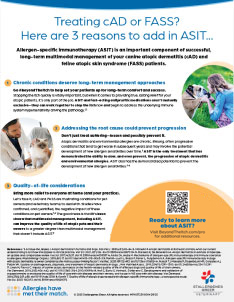


Environmental allergy testing
The purpose of allergy testing is to inform customized immunotherapy formulation – not to diagnose allergies.


Allergy testing is indicated following a diagnosis of atopic dermatitis/
environmental allergies after other causes of itching — such as fleas, infections, and food allergies — have been ruled out and the owner is interested in addressing the root cause with immunotherapy.
The purpose of allergy testing – whether serum or skin – is to help determine which specific allergens within their environment a particular patient’s immune system is overreacting to and should be considered for inclusion within a customized ASIT formulation.7
A note about serum testing and food allergies: Currently available serum allergy tests are of no value in the diagnosis and management of food allergies. A properly conducted diagnostic (elimination) diet trial is the gold standard for diagnosing or ruling out food allergies in cats and dogs.15
Setting pet owners up for treatment success
A long-term condition requires a long-term approach
Commitment is key2-4,7
- ASIT efficacy is strongly correlated with treatment duration, with 12 months being the recommended minimum time required to evaluate a pet’s response to treatment.
- Animals treated ≥12 months showed higher efficacy rates than those treated <12 months (65% vs 22%).3
- Animals treated ≥12 months had their concomitant medications reduced more than animals treated <12 months (87% vs 39%).3
- Some pets may show improvement earlier, but pet owners should commit to administering ASIT for at least 12 months before deciding whether the therapy is helping their pet.


Establishing ASIT success metrics
- About 60%-70% of animals treated with ASIT have a positive response and a reduction in pruritus.16,17
- Successful ASIT treatment may also include reduced need for symptomatic and other allergy medications, fewer or less severe allergy flares, slowing or preventing new sensitizations, fewer secondary infections, and/or improved quality of life.1,3,5,12
Improved quality of life goes beyond the atopic pet to include pet owners’ quality of life as well12
- In a 2023 study of record reviews and recollections, owners of dogs treated with ASIT recalled a significant improvement in their daily activities and sense of well-being, plus a reduction in expenses, compared with pet owners not treating with ASIT.12

ASIT success stories

A loveable therapy dog’s own journey with allergen-specific immunotherapy

A best friend’s story from relentless itching to real relief

A cat’s tale of environmental allergies and success with immunotherapy
References: 1. Marsella R, De Benedetto A. Atopic dermatitis in animals and people: an update and comparative review. Vet Sci. 2017;4(3):37. doi:10.3390/vetsci4030037 2. Miller J, Simpson A, Bloom P, et al. 2023 AAHA management of allergic skin diseases in dogs and cats guidelines. J Am Anim Hosp Assoc. 2023;59(6):255-284. doi:10.5326/JAAHA-MS-7396 3. Ramió-Lluch L, Brazís P, Ferrer L, Puigdemont A. Allergen-specific immunotherapy in dogs with atopic dermatitis: is owner compliance the main success-limiting factor? Vet Rec. 2020;187(12):493. doi:10.1136/vr.106024 4. Olivry T, DeBoer DJ, Favrot C, et al. Treatment of canine atopic dermatitis: 2015 updated guidelines from the International Committee on Allergic Diseases of Animals (ICADA). BMC Vet Res. 2015;11:210. doi:10.1186/s12917-015-0514-6 5. Arcique MA, Bajwa J. Atopic dermatitis in humans and dogs. Can Vet J. 2020;61(1):82-84. 6. Drechsler Y, Dong C, Clark DE, Kaur G. Canine atopic dermatitis: prevalence, impact, and management strategies. Vet Med (Auckl). 2024;15:15-29. doi:10.2147/VMRR.S412570 7. Mueller RS. A systematic review of allergen immunotherapy, a successful therapy for canine atopic dermatitis and feline atopic skin syndrome. J Am Vet Med Assoc. 2023;261(S1):S30-S35. doi:10.2460/javma.22.12.0576 8. Marsella R. Atopic dermatitis in domestic animals: what our current understanding is and how this applies to clinical practice. Vet Sci. 2021;8(7):124. doi:10.3390/vetsci8070124 9. Shida M, Kadoya M, Park SJ, Nishifuji K, Momoi Y, Iwasaki T. Allergen-specific immunotherapy induces Th1 shift in dogs with atopic dermatitis. Vet Immunol Immunopathol. 2004;102(1-2):19-31. doi:10.1016/j.vetimm.2004.06.003 10. Veneziani I, Landolina N, Ricci B, Rossi O, Moretta L, Maggi E. How the immune system responds to allergy immunotherapy. Biomedicines. 2022;10(11):2825. doi:10.3390/biomedicines10112825 11. Akdis CA, Akdis M. Mechanisms of allergen-specific immunotherapy and immune tolerance to allergens. World Allergy Organ J. 2015;8:17. doi:10.1186/s40413-015-0063-2 12. Kotnik T. Quality of life of allergic dogs treated with allergen-specific immunotherapy—a retrospective study. Vet Sci. 2023;10(2):72. doi:10.3390/vetsci10020072 13. Zur G, White SD, Ihrke PJ, Kass PH, Toebe N. Canine atopic dermatitis: a retrospective study of 169 cases examined at the University of California, Davis, 1992-1998. Part II. Response to hyposensitization. Vet Dermatol. 2002;13(2):103-111. doi:10.1046/j.1365-3164.2002.00286.x 14. Park S, Ohya F, Yamashita K, Nishifuji K, Iwasaki T. Comparison of response to immunotherapy by intradermal skin test and antigen-specific IgE in canine atopy. J Vet Med Sci. 2000;62(9):983-988. doi:10.1292/jvms.62.983 15. Jackson HA. Food allergy in dogs and cats; current perspectives on etiology, diagnosis, and management. J Am Vet Med Assoc. 2023;261(S1):S23-S29. doi:10.2460/javma.22.12.0548 16. Fennis EEM, van Damme CMM, Schlotter YM, et al. Efficacy of subcutaneous allergen immunotherapy in atopic dogs: a retrospective study of 664 cases. Vet Dermatol. 2022;33(4):321-e75. doi:10.1111/vde.13075 17. Outerbridge CA, Jordan TJM. Current knowledge on canine atopic dermatitis: pathogenesis and treatment. Adv Small Anim Care. 2021;2:101-115. doi:10.1016/j.yasa.2021.07.004